Architecture overview
Architectural approach
-
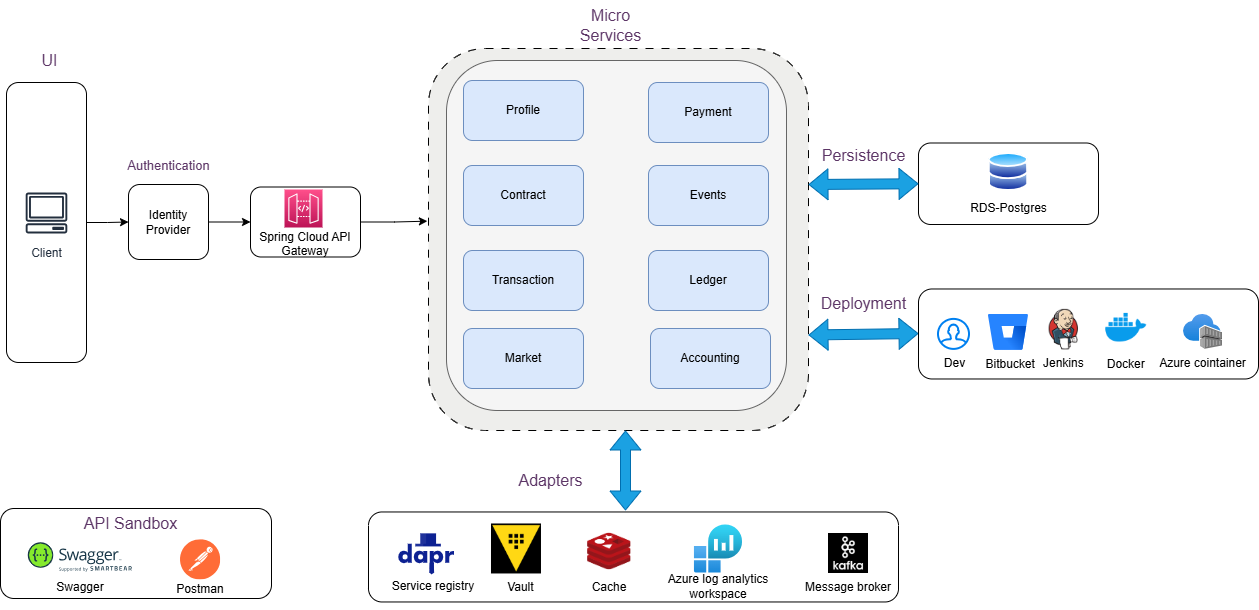
SolitX follows a modular architecture inspired by microservices principles, where functionality is organized around well-defined business capabilities.
-
The platform consists of approximately 70–80 REST APIs, grouped into modules (collections) such as Profile, Contract, Transaction, Ledger, Accounting, Payment, and Events.
-
Each module represents a distinct business capability and owns its functionality end to end.
-
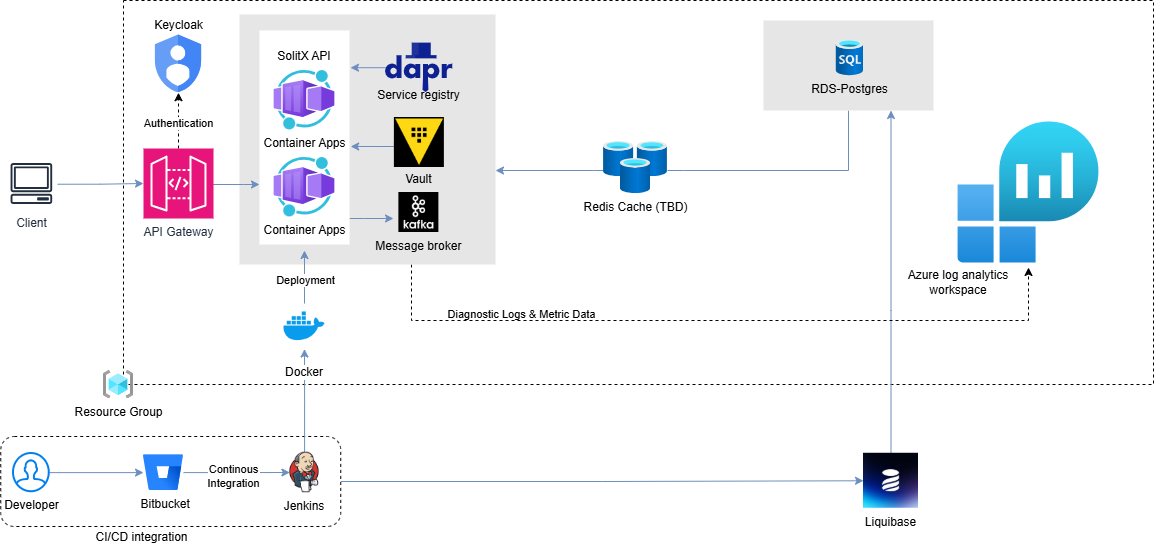
All client requests are routed through a single API Gateway, which integrates with an identity provider for authentication and acts as the unified entry point to the platform. This ensures consistent security, routing, and cross-cutting concerns across all services.
-
Each module is deployed as an independent container, and together these modules operate as a single logical application.
-
Strong module boundaries are enforced so that services do not directly access each other’s internal logic, maintaining clear ownership and loose coupling.
-
The system uses a shared PostgreSQL database, with module-aligned changelogs to establish logical data ownership.
-
While the database is shared, strict governance and conventions preserve modular boundaries and enable controlled collaboration across services.
|
This approach balances operational simplicity with microservices-style modularity, reducing infrastructure overhead while improving maintainability, scalability, and code ownership. It also provides a clear evolution path toward fully independent microservices if stronger isolation is required in the future. |